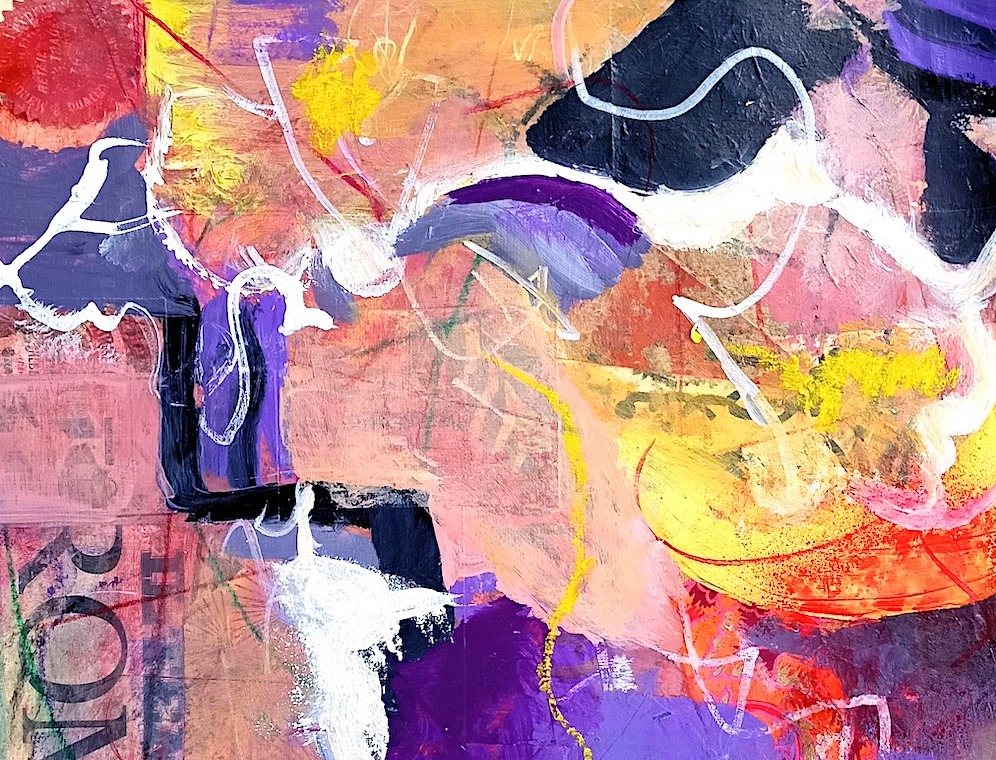
Painting by Bev Jackson
From Tom Dooley, Managing/Fiction
Many thanks to former fiction contributor Beverly Jackson, whose artwork brightens up this issue. The pieces you see are in many cases excerpted from larger and even more fantastic works. I regularly see and admire Bev's work on Facebook, and I somehow convinced myself she had already BEEN in Eclectica. When I realized she hadn't, I was super psyched when she agreed to it.
I've said it before, but kudos and thanks to Chris and Marko, who continue to crush it in their respective roles as poetry and nonfiction editors. The poetry section could easily stand alone as its own literary publication.
The fiction section is another batch of goodness, and I'm happy to welcome back Kavita Dorai, whom we previously published 21 years ago, and Iyesatta Massagoi Emeli, notching her third appearance. Vic Sizemore was in our nonfiction section a couple times about a decade ago, and we last heard from Brad Gottschalk in 2019. As always, it's gratifying to see these "repeat offenders," just as it's exciting to have newcomers we hope to see again down the road.
Among the newcomers is Scott Solomon, whose "To Whom Much Is Given" made him one of this issue's Spotlight Runners-up. A curious piece, it strikes me as a short-story analog to Billy Joel's "We Didn't Start the Fire," capturing as it does the way generational forces shape an individual.
Some quick shout-outs to a few of our "alums":
•Nicholas Barnes' debut poetry chapbook, Restland, is available for preorder from Finishing Line Press.
• Also from Finishing Line, Patrick Kindig's debut poetry collection fascinations.
• Timothy Gager's Shadows of the Seen is also available for pre-sale.
• Jessica Anya Blau has a new novel out called Shopgirls.
• Meg Pokrass is getting good reviews for her collection of stories, First Law of Holes.
• Perhaps the biggest buzz of the Eclectica literary universe belongs to Ron Currie, though, whose The Savage, Noble Death of Babs Dionne has been called "Maine's answer to Fargo" and heartily endorsed by the LA Times, Oprah Daily, and many others.
For up-to-date news on these and other authors, check out our Facebook group and page, and please drop me a line if you have news to share.
In closing, I'll mention that last night I watched the first episode of this season's Black Mirror, and I found it pretty damned depressing. Probably, if you're actually reading stuff in online literary magazines, you're finding quite a few things in the world these days to be less than encouraging for the fate of humanity. At least for now, though, you can read the contents of this website, free of paywalls, subscriptions, upselling, advertisements, or corporate (or government!) censorship. And while there are some AI-generated illustrations in Brenda Hammack's miscellany piece, you shouldn't find anything else in these pages that wasn't pecked into a laptop at a kitchen counter by a flawed-but-human being. By virtue of not being "worth" anything, that's all got to be worth something, and I hope it gives you some kind of comfort.
Have a great summer, and we'll see you on the other side.
From Marko Fong, Nonfiction
In Eve Goldberg's "Two Chocolate Truffles" the narrator takes a risk for the sake of love: she smuggles in treats for her imprisoned girlfriend. It's a bit of sweetness in an environment where luxury and privacy have intentionally been made scarce. It's also a fascinating look at the community of individuals who find ways to show love to incarcerated partners. That would be enough to make it a spotlight runner-up for this issue. It's not directly compared in the article, but part of what makes the article especially fascinating is that Linda spent 16 years in prison for her involvement with planting a bomb in the US Capitol that ultimately hurt no one as a protest against American foreign policy in the early '80s. One key difference is that she was protesting real transgressions against democracy. I suspect there's no need to comment on the other difference with another attack on the Capitol.
Ping Yi Yee introduces us to the intricacies of a 122-year-old railroad line that crosses both Singapore and Malaysia through "When Iron Leaves the Land." In the process he shares some of the sights along with details of the history of the line while tying in his personal history and its connection to both his wife and his own writing process. Gloria Gonsalves shares her experience as a staffer at a UN Climate Change conference held in Durban, South Africa. It's a meditation on how the climate change debate looks to someone from an underdeveloped country, which she ultimately contrasts with facing the frustration of how the conference looks to "ordinary" individuals in Durban at a time when serious action is critical. In "Rafting in Beas River," Rituparna Sahoo shares a memory of a rafting trip in Northern India with her father. The rapids become a metaphor for her difficult relationship with her father who ultimately can't sustain a moment of shared joy with his daughter. At the end, we get a glimpse of the neurodivergent daughter as she struggles with the mixed emotions that come with the end of the outing. Ann Yuan's "Something They Taught You in High School" is a fine example of how many good humor pieces work: set it up, get out quickly, and end with a shock to the reader's expectations.
When I first read Brenda Hammack's "Living Dead Woman Sonnets" my first instinct was to turn them over to Christine for the poetry section. It took me a bit to recognize they were a perfect fit for our ever elusive "Miscellany" section. The five poems set up a haunting conversation with matching AI-generated pictures.
Speaking of pictures, I want to send a shout out to the talented writer and artist Bev Jackson, who provided the artwork for the rest of this issue.
From Christine Potter, Poetry
"Pass Up Your Chairs! Save The Human Race!" —Thornton Wilder, The Skin Of Our Teeth
I don't want to say I'm superstitious, but I am one of those people who thinks pretty hard about through-lines and coincidences. I believe life rhymes. ( I also believe there are ghosts in my house. Our place is over 200 years old and there's weirdness sometimes. But I digress...) Where was I? Oh, yeah. Poetry. Through-lines. Right.
So many of the poems that volunteered for Eclectican service this time issue turned out to be about prison and liberation, grief and joy. Considering the state of the world, I guess that's not surprising! We have an astonishing, brave new ghazal from Jamie Silvonek, an incarcerated college student and activist. I knew we had to run that one as soon as I read it.
Right after being blown away by Jamie's work, I was deeply moved by Bob Bradshaw's "Living On Planet Nine." Bob's narrator is in an elder care facility, and equally imprisoned. But then there's the sun-struck grace of Tina Denetclaw's "Going With Dad To Check The Cattle," with its powerful images of Ship Rock and its closing lines from the Navajo blessing "In Beauty I Walk." Surely, there can be no greater liberation than that. Or joy, really. I love how those poems fit together!
I had decided to open the section with one of those things my undergrad poetry teacher warned me away from writing: an ars poetica, a poem about poetry. Mary Jo Robinson-Jamison's enviable prose poem "Poesis" says poetry slips under its writer's door like the scent of night air after a rain. She had me at night rain. And then she hit me with another terrific poem about trying to grab a living fish out of ice-cold water, and an equally fine one on a line by Rainer Maria Rilke. All three poems are joyful in their own ways. Here's the weird thing: just after I popped them into the section, New York City poet Terese Coe sent us a fine translation of some related Rilke! She'd also translated a witty little poem by Heine. They fit in perfectly. But then the other editors saw Mary Jo's poems. They ended up being selected for the Spotlight, which we decide upon together.
We have two funny, wildly imaginative poems by Eric Hadley—one an oddball meditation about tap water and milestone "birddays" and the other one utterly bent—but maybe the sweetest love poem I've read in ages. Eric's been in before, and I like his stuff more and more.
There's also a poem that riffs on an old school murder ballad. Sue Blaustein's "The Ballad of Walters Grocery" is about a corner store owner who shot and killed a robber. The narrator is what lifts it out of genre: it's spoken by a health department inspector who checks out the shop after the stick-up, which swerves the poem into instructions on how to get through this world without getting murdered or terrified. That's advice we could all use right about now.
I also admire the main poetry section's closer: a super-smart and musical villanelle on looks, age, and gymnastics by T.R. Poulson.
Prose poems, haibun, a ghazal, a villanelle—and those translations! We've got it all this time. And here comes a solid group of Word Challenge Poems! I knew when I put "sodden" and "adagio" in the four words each poet needed to include, people would be writing about the saddest piece of music in the whole world, Albinoni's Adagio in G minor. Fun fact: Albinoni didn't write it; a 20th century Albinoni scholar named Giazotto did. It'll make you cry every time, no matter who is responsible—and yeah, the piece did show up, in a vivid poem about memory and addiction by Betsy Lynch. Here, it's uplifting rather than sob-inducing.
Judy Kaber's excellent shaped poem "My Husband Comes Back From The Dead" will make you cry, though. I contributed a short poem about trying to escape the current political climate by looking at old houses online and fantasizing about buying them all.
That current political situation is what brings me to my last point: I am grateful to read all the poems that come into Eclectica every issue and weave what I believe are the best of them into a section of this magazine. Truly, most of what gets submitted to us is pretty darn good. What a joy to know the world is so rich with poetry that people just send it to us! I try to look at everything twice before I decide what goes in and what doesn't. Poetry is the place where we tell the truth, even when we think we're making it all up. It's magic that way. That's why I believe it will save us all yet.
By the way, next issue's Word Challenge words are unity, sunset, spoon, and moss. Let's see what you can do with them! Use them in a poem of any size or style. Game's on, and it's a free submission! So let me close by echoing Thornton Wilder's Stage Manager from The Skin Of Our Teeth: Pass up the chairs, everybody! Save the human race! And pass up a poem to us while you're at it. Meanwhile, luxuriate in this darn fine poetry section. See you all next time.