"History will have to record that the greatest tragedy of this period of social transition was not the vitriolic words and violent actions of the bad people, but the appalling silence and indifference of the good people. Our generation will have to repent not only for the words and acts of the children of darkness but also for the fears and apathy of the children of light." —MLK 1965
It was almost 80 degrees in Durham on the morning of April 5, but by the end of the afternoon, it felt even warmer. My wife and I were pedaling our bikes the six and a half miles to CCB Plaza in Downtown Durham for the Hands Off rally; we figured parking the Cybertruck nearby wasn't going to be the best idea. (Kidding!) During the week, I'd gone back and forth with her about going instead to Raleigh, the state capital, 20 miles away. I argued more people would be there and thus more likely to attract media attention. I'd seen an online post about organizing rides from Durham to Raleigh to support the bigger rally. My wife insisted we should be "representing" in our own community. Her agreement to ride our bikes was a bribe to get me onboard with the protest version of "eat local." Instead of one large rally in a major city, multiple rallies even in very small towns—Durham's a mid-sized city—happens to be the strategy for "Hands Off," one of many groups organizing these events.
The ATT trail was busier than usual, but nearly all the bike riders, dog walkers, skateboarders, and one guy on a modern version of a penny farthing (19th century giant-front-wheeled predecessor to the modern "safety bicycle") appeared to be out either for exercise or sunshine amongst newly-leafed trees. Around a half mile from CCB Plaza, we passed a pedestrian carrying a protest sign. I announced to my wife, "I guess there will be three of us there."
She pretended not to hear me. After we passed the baseball stadium and the performing arts center, we stopped at a crosswalk two blocks from the plaza, and I saw two more pedestrians bearing signs about saving Medicare and the VA. "We're up to five now."
Again, my wife ignored me.
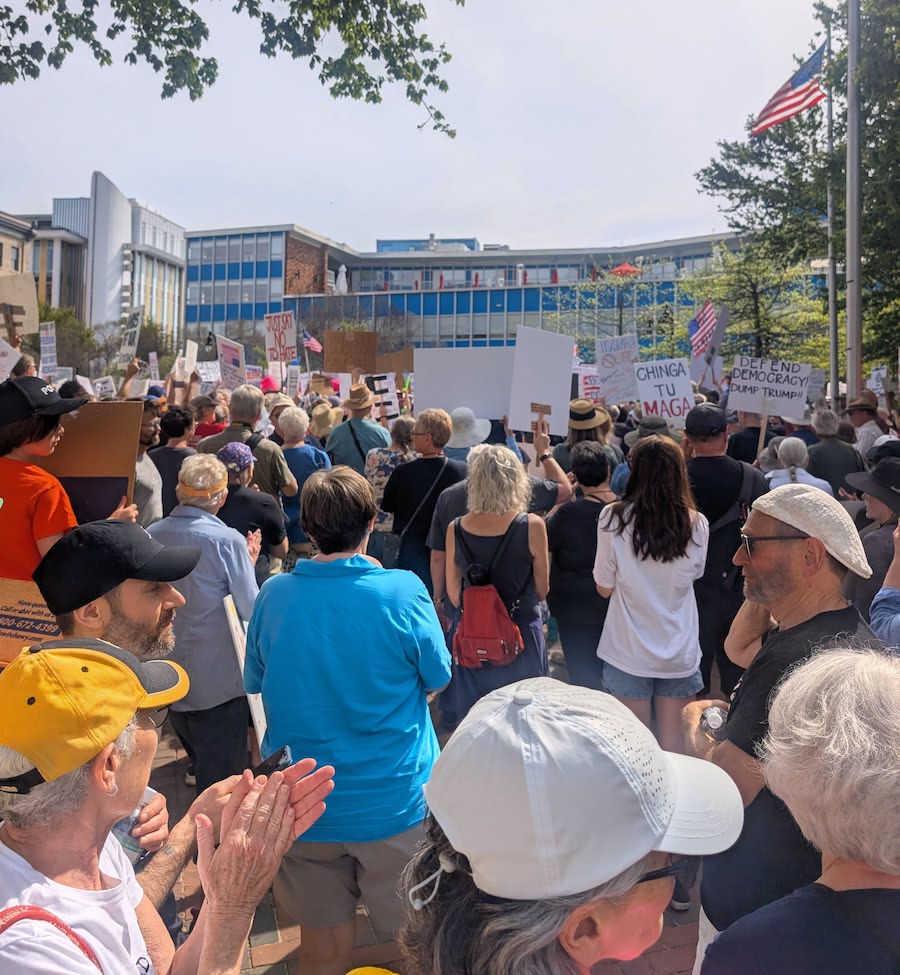
Arriving 20 minutes before the rally's start, we locked the bikes across the street from CCB Plaza. The space was already packed with fellow protesters and hundreds of hand-made signs. I felt inspired in a good way for the first time since the November election. You know that scene at the beginning of the Barbie movie parodying Kubrick's 2001—with early humans, mouths agape and eyes wide at the appearance of the monolith as they suddenly attain enlightenment? I now understood at a much more personal level. Possibility!
My wife didn't gloat.
Just as encouraging, two of our neighbors happened by. We had a five minute conversation mostly consisting of, "Unbelievable!"
Meanwhile, HAL was somewhere on a Spacelink satellite, eliminating government jobs, peering down at us, planning his AI takeover of critical functions, all while singing "A Bicycle Built for two."
Some Durham History Stuff
CCB Plaza in Durham's best known feature is our city's avatar: a ten-foot tall, one-ton metal statue of a giant bull erected in 2003.
Before Bull Durham was a Kevin Costner-Susan Sarandon movie, the city's biggest industry wasn't livestock but tobacco, a consumer product that became exponentially more popular after Jame Duke became one of the first entrepreneurs to take advantage of mechanized cigarette rolling, while W.T. Blackwell modernized the storage and production of loose leaf tobacco through a product that came to be known as Bull Durham. Though it's hard to imagine mustard-infused tobacco, Blackwell took inspiration from the bull logo used by a successful mustard company based in Durham, England.
The unrepentant Klan member Julian Carr later ran Bull Durham tobacco and built it into an international brand with the help of ads featuring primitive caricatures of Negroes saying things like, "My! it sure am sweet tastun." When I moved here, I first thought the bull was there because the plaza used to be the site of a Merrill Lynch Office. The bull happens to sit at the corner of Corcoran and Parrish Streets, the site of what Durham proudly calls Black Wall Street, similar to but not to be confused with Tulsa's Black Wall Street destroyed by a White supremacist mob in 1921. Unlike Tulsa's, Durham's Black Wall street survived and prospered for decades.
Before mechanized cigarette rolling, Duke and others had brought roughly 125 Eastern European Jews to Durham to hand roll cigarettes. The Jewish workers tried to organize, and the owners did their best to send them away. Meanwhile, emancipated blacks were hired in large numbers to work the warehouses. Eventually some of those workers became supervisors.
One result was that Durham became one of the first southern cities to develop a Black middle class. Two Black-owned companies appeared on Parrish Street, North Carolina Mutual Insurance and the Mechanic and Farmers Bank, to help Blacks save their disposable income and invest. John Merrick, the Black barber who played a role in founding both institutions, was supported and financed in part by the Dukes and by avowed White supremacist Julian Carr. Fwiw, Carr supported women's suffrage and also sponsored a Chinese cabin boy who jumped ship in Wilmington. Charlie Soong eventually returned to China, ran a Bible publishing business, and fathered both the wife of Sun Yat Sen and Madame Chiang Kai-Shek. History can be both complicated and surprising at times. Like the leader of the 19th century Populist Party Thomas Watson, who was both a progressive and a racist, Carr was both a prisoner of his time and saw beyond it in ways.
Two doors from 116 Parrish St, the onetime headquarters for North Carolina Mutual and Mechanic and Farmers Bank, the four stories tall Unscripted Hotel directly overlooks CCB Plaza. An outdoor pool prominently fronts the third floor. Before it was revived as the Unscripted, the property was the Jack Tar Motel, a mid-century modern steel and glass structure built in 1962 that contrasted with the older brick-framed buildings of Durham's downtown. It fell into disrepair after it closed in 1977, and for some time it became a de facto housing project until it was lovingly renovated in 2017 as the Unscripted. Durham's hotels and restaurants desegregated between 1963 and 1964, some before and some after the Civil Rights Act of 1964. Martin Luther King, who had just won the Nobel Peace Prize, addressed the Southern Political Science Association at the Jack Tar Hotel that year. Durham's Black middle class served as a reliable source of King's support; he visited the city often.
If you've seen photos of Durham's Jack Tar Hotel and Memphis's Lorraine Motel where Dr. King was assassinated by a White supremacist in 1968, you'll notice a haunting physical resemblance. While the Lorraine is just two stories instead of four, the motels share a mid-century modern motif with steel and glass structural elements accented with brightly-colored street-facing room doors. In 1968, Dr. King cancelled an appearance in Durham in order to go to Memphis. The visual resemblance between the Jack Tar and the Lorraine and their connection to Dr. King isn't entirely coincidental. Mid Century Modern was a deliberate choice to announce a new age in travel. The Motor Hotels (motels) of the '50s and '60s served as the justification for the Federal Government forcing private businesses serving the public to serve all the public. The Department of Justice argued the Federal Interstate Highway system was meant to be accessible to all motorists: Blacks couldn't use the Interstate if they couldn't dependably find a place to eat, sleep, or buy gas while traveling across state lines.
When access to public accommodations was up to the states before 1964, access for all races was uneven at best, and not just in the South. For decades the Lorraine Motel was listed in the Negro Motorist Green Book (my wife loves Viggo Mortensen, but I still find it strange that Hollywood somehow made a Danish-American guy the hero of a movie about the Green Book). Similarly, the reason we still barely have a Federal Department of Education is that schools didn't desegregate immediately after Brown vs. Board of Education in 1954, and students with disabilities weren't being accommodated, educated, or accounted for under local or state control.
As someone who was alive when Dr. King was, I remember the many prominent signs in Sacramento restaurants in the early '60s saying, "We reserve the right to refuse service to anyone." The signs in Sacramento persisted well past the passage of the Civil Rights Act of 1964. The law, of course, had nothing to do with business owners having the right to remove unruly customers. It just meant they couldn't refuse customers based on race or other immutable characteristics. "End DEI" is those signs in a different guise. Diversity, Equity, and Inclusion has never meant that you have to hire or promote unqualified people. The programs ensure qualified members of protected groups get hired and promoted, too. Meanwhile, I tried to imagine Martin Luther King's ghost on April 5, 2025, standing on the third floor of the one-time Jack Tar Hotel, looking down—hopefully approvingly—at the thousands in CCB Plaza... protesting, among other things, the Trump Administration's attempt to eliminate all vestiges of DEI. The fact that this is an issue in 2025 is certainly bittersweet for anyone who still shares Doctor King's dream.
The Size and Composition of the Crowd
For various reasons, the media has difficulty estimating the size of public rallies. In 2017, the first Trump administration took advantage by claiming his inauguration had been attended by a record-setting crowd. The much larger Women's March shortly thereafter was likely three times bigger, but conclusive totals stayed elusive. As part of firing thousands of Federal workers, the current administration is also, likely intentionally, crippling our capacity to count and track things like climate change, hiring disparities, misappropriated funds, tainted foods, new virus cases, industrial safety/pollution, missing detainees, children growing up in poverty, corporate and billionaire tax fraud, and actual waste.
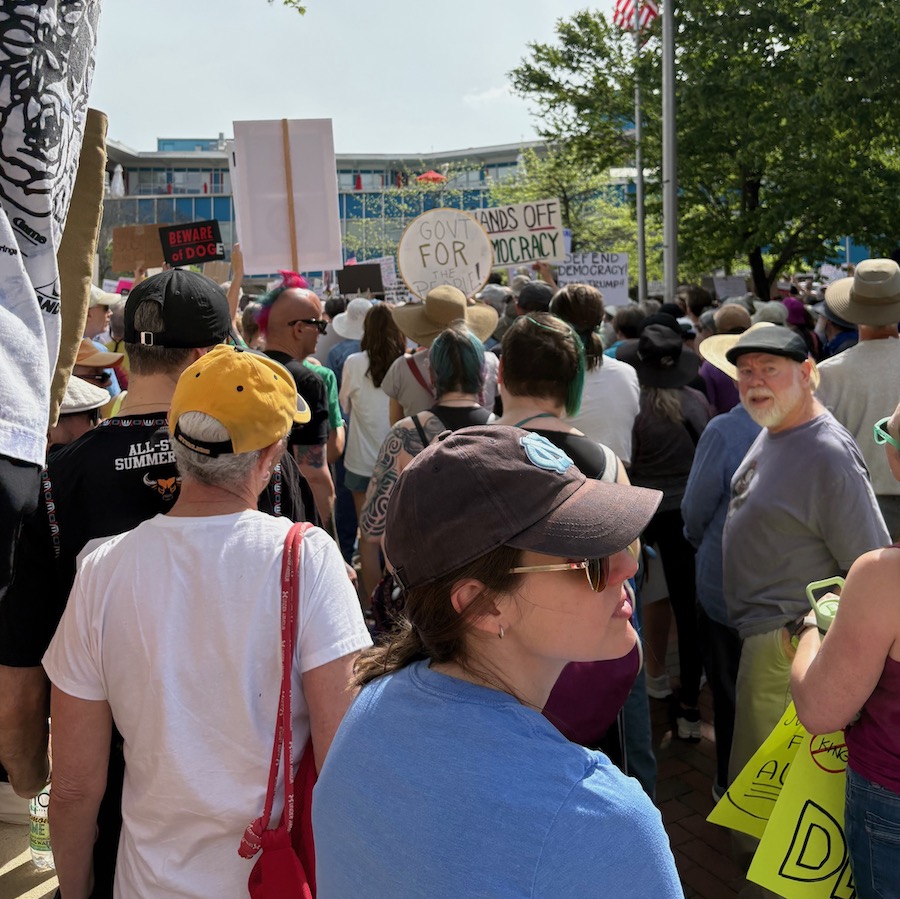
After the Durham rally, I looked for crowd-size estimates and only found one in the Raleigh News and Observer saying something to the effect of thousands across the Triangle (multiple rallies). Let me suggest a method. CCB Plaza is 22,000 square feet. The plaza was shoulder to shoulder, and there were lots of people on the sidewalks across the street from the plaza. At one point, the organizers got the attendees to march on the sidewalks around the plaza (you can do so in Durham without a permit). The plaza remained full even as the sidewalks teemed with chanting, ambulating protesters. The rule of thumb for standing room only is six square feet per person. Even after accounting for the bull statue and racks of clothing from a swap meet, I get 3,000 or more at the Durham rally alone.You would almost have thought that Duke had just won a game in the Final Four (they happened to be playing one that night, but didn't win). Without a doubt, the actual size of the April 5 rallies was clearly underreported in the mainstream media.
The crowd reminded me of the '60s, possibly because much of the crowd remembered the '60s. Although many of those present were young (some very young) and/or not White, the protesters still skewed older and Whiter. Durham is roughly 40 percent White and 40 percent Black. It's also now, somewhat surprisingly, 15 percent Hispanic. A lot of the signs were about the threats to Social Security, Medicare, the Veterans' Administration, and the loss of value to invested savings: all matters of immediate concern to the Baby Boom generation and growing concern for Gen X.
In 2024, voters over age 50 strongly favored Trump and voted Republican. The age gap is especially pronounced for Baby Boomers. According to Pew, the older part of that cohort (80-year-olds) broke 58-39, while the younger part of the cohort born from 1955-1965 was 53-43. Durham's a very blue city, and most if not all at the rally never voted for Trump. Many there first associated the Kennedy name with either John or Bobby instead of RFK Jr. (now 71) as the Secretary of Measles Exposure. While the chant "Hey Hey Ho Ho Trump and Musk have got to go!" echoes the long ago "Ho Ho Ho Chi Minh NLF is going to win!" (it wasn't just Jane Fonda back then), it maybe should have been "Sorry Gen Z, we Boomers f***ed up your future!"
It's easy to understand why Durham's Hispanic population wasn't there: just being seen at a public protest might be a due process free ticket to a Salvadoran prison for a photo op with Kristi Noem. The relative lack of Black protesters in Durham may also be partly the product of intimidation, given the sometimes violent rhetoric directed both at DEI and Black Lives Matter protesters, many of whom weren't Black. When Jacob Rittenhouse shot three protesters in Kenosha, Wisconsin, his victims were White, but it was a Black Lives Matter rally. Certain forms of open peaceful dissent, once a sacred fundamental right in America, simply aren't safe for everyone unless they happen to be older and Whiter (so far at least).
The relative absence of Black protesters on April 5 may, however, be more complex and more deeply rooted. The gentrification of downtown Durham has slowly pushed poor Blacks out of the district. Downtown also happens to sit adjacent to Hayti, a parallel and once vibrant African-American city within a city. Hayti's single family homes and small businesses grew alongside North Carolina Mutual and the Mechanics and Farmers Bank until the area fractured and faded due to redevelopment, desegregation, and other factors. The decline of Hayti stands as one of many reminders that 60 years ago, too many Americans saw legal desegregation as a complete solution to a complex problem.
Modern Durham is a city with minority majority political leadership: the mayor Leonardo Williams is African-American, as are three of the seven city council members. A fourth city council member is Latina. If, however, you look at Business North Carolina's annual "Power List" of business and cultural influencers in the Triangle, the faces turn noticeably Whiter. Today's Parrish St. hosts several Black-owned businesses, but the six-story building that once housed North Carolina Mutual is dwarfed by the 27-story One City Center, developed by Austin Lawrence Partners, the same group that restored the old Jack Tar as today's Unscripted Hotel. The Durham Hotel, the Mad Men set-like cousin on the other side of the Unscripted, was developed by Maverick Partners. Phillip Szostak was behind DPAC, the showcase performing arts center just across the railroad tracks. Greenfire Development renovated Carolina Central Bank (the CCB in the plaza). If you look at the "about us" pages for all four groups behind the big money revitalization of downtown Durham where Black Wall Street once stood, you'll see almost exclusively White faces. In any case, the city's Black political leadership and the developers behind the shinier bigger structures around CCB Plaza weren't strongly in evidence at the April 5 rally. To be fair, I can't say they weren't there, either.
The plaza is less than two miles from two large universities: Duke and North Carolina Central. While there were younger rally goers, there was no clear contingent from either school, no clusters of young people who all seemed to arrive at the rally together. Contrast this with the pro-Palestinian protests in 2024, which were largely university based and resulted in some 3,500 arrests. Fear around recent deportations and student visa cancellations for protests now characterized as Pro-Hamas may account for some of the reduced numbers of college-aged protesters. In the '60s, many protests focused on the War in Vietnam, and those who marched, sat in, etc., were close to draft age. Sixty years later, large numbers of students get their student loans through the Federal government. Meanwhile, tariffs and Social Security don't exactly get younger people excited enough to do anything more than watch the protests on their phones between Minecraft turns. That said, I would argue advocacy for the Constitution shouldn't be a function of age or race. It's also possible most of the students went instead to the rallies in Chapel Hill or Raleigh.
Hands Off, 50501, et al, did an incredible job of organizing and getting such a huge turnout in Durham. To sustain critical mass however, I suspect it needs to look at ways to get greater participation from the many younger and/or non-White community members also frustrated with the excesses of Trump-Musk. Reverend William Barber, who led the Moral Mondays protests that started in North Carolina a decade ago, took part in the DC Hands Off rally on April 5. The Moral Mondays organizers also helped with the planning and spoke at the Raleigh rally. I've been looking at photos of earlier Moral Mondays events and have noticed the crowds for those were Blacker and younger. The Hands Off rallies recruited largely with the Internet through sites like Mobilize.us. Moral Mondays built through a network of churches.
I also wonder about another critical group. Elected Democratic politicians have been present at many of the rallies. For example, Jamie Raskin, Ilhan Omar, and Eric Salwell spoke at the DC rally. Bernie Sanders and Alexandria Ocasio-Cortez have taken their Fighting Oligarchy tour to red-leaning cities like Bakersfield, Salt Lake City, and Missoula, and been met by crowds of 10,000 plus. Cory Booker went from his 25-hour filibuster to address a Town Hall on April 5.
That said, I've looked and can't find any involvement from Chuck Schumer or Hakeem Jeffries, the current ranking elected Democrats. I also looked for our recently elected Democratic governor Josh Stein's and my Congressperson Valerie Foushee's connection to any of the rallies and have turned up nothing. Maybe it's a good thing the 1,300 April 5th rallies aren't seen as Democratic Party events in the way MAGA rallies are Republican Party events. Still, a part of me is wondering, "What the hell?" and, "Which side are some of you really on?" Showing up might be performative, but not showing up or acknowledging it is, too, in its own way.
More Scenes from CCB Plaza
The event was supposed to start at 11:00, but it was actually hard to tell how and when it started, partly because we were on the surrounding sidewalk. A few minutes past, a woman suddenly appeared a couple feet above the throng to speak into a hand-held mike connected by a coiled black wire to a flugelhorn-sized megaphone held in her other hand. We had no idea who she was or what she was saying. I was tempted to run to Costco to buy a maybe overdue hearing aid, but it was also clear no one more than 30 feet away from her could hear clearly, either.
This may speak to the genuinely grassroots origins of the CCB Plaza rally. No banner-festooned dais or rock-concert-sized sound system awaited the protesters. In fact, some of the street musicians who frequently play near CCB Plaza have better amplification. There also didn't seem to be a clear order of events for the hour-and-45-minute gathering. Perhaps, the organizers, too, were surprised by the turnout. In any case, the sense of genuine spontaneity was inspiring. Even more inspiring, as disorganized as the rally appeared at times, the rally goers remained impressively peaceful and orderly. Except for a couple brief moments, they didn't even block car traffic in the surrounding streets. Many of the passing cars and trucks honked their horns to show support, something unfailingly met by cheers from the crowd. Meanwhile, the subsequent speakers in the plaza took to leading anti-Elon-Donald chants. I struggled to figure out the words to the chants as well.
I've never attended a MAGA rally, but I have streamed some, and I've read reports: they were covered repeatedly and extensively for years. The differences are pretty stark. The Durham rally had no vendors selling red or any other kinds of hats, tribal paraphernalia, or t-shirts prior to the event. Almost all of the signs appeared to be home made instead of the commercially produced ones more common at MAGA rallies. As mentioned, there was no grandstand with hand-selected, often paid non-White participants to stand in front of the TV cameras and behind the speakers. There were no music acts or unauthorized playing of popular songs played through a PA. There was no schedule for the event. There were also no TV cameras or on-the-scene press coverage. I did spot one tripod-mounted video camera, but neither the camera nor its operator bore any evidence of a station affiliation.
MAGA rallies and Hands Off rallies do have two things in common. The participants tend to be Whiter and older. Trump was the most shouted name and his name and likeness appeared most frequently on the signs. At the Hands Off rally, Elon was a close second.
MAGA metastasized around the Mango Mussolini. A cult of personality has yet and may never emerge from Hands Off. Having a single face of a movement has its dangers, clearly, but the mainstream Civil Rights movement certainly benefited from having an identifiable face in Martin Luther King. At the moment though, it appears to be primarily an anti-Trump-Musk phenomenon. Hands Off's implied goal seems to be the removal of the tumor of governance by tirade of grievance in place of thoughtful specific policy or at least the illusion of such. For short term success, social-political movements may not need identifiable leaders or enemies, but without more affirmative principles and goals, long term change may be elusive. The anti-war rallies in the '60s did quite successfully prevent LBJ from running for re-election in 1968, but America only withdrew from Vietnam in 1973 (almost a year after Watergate), and the war didn't end until 1975. Since then, the military-industrial complex has stayed intact and is now being overseen by Pete Hegseth (who needs the Pentagon Papers when the Secretary of Defense shares information via Signal?). In the 50-plus years since, the US hasn't exactly broken the habit of engaging in ultimately pointless foreign wars.
I fear that if Trump or anti-Trump remains the primary source of oxygen for both sides, we risk the danger of condemning ourselves to nothing more than a different set of oligarchs running the government for their own benefit.
Signs Signs Everywhere Signs
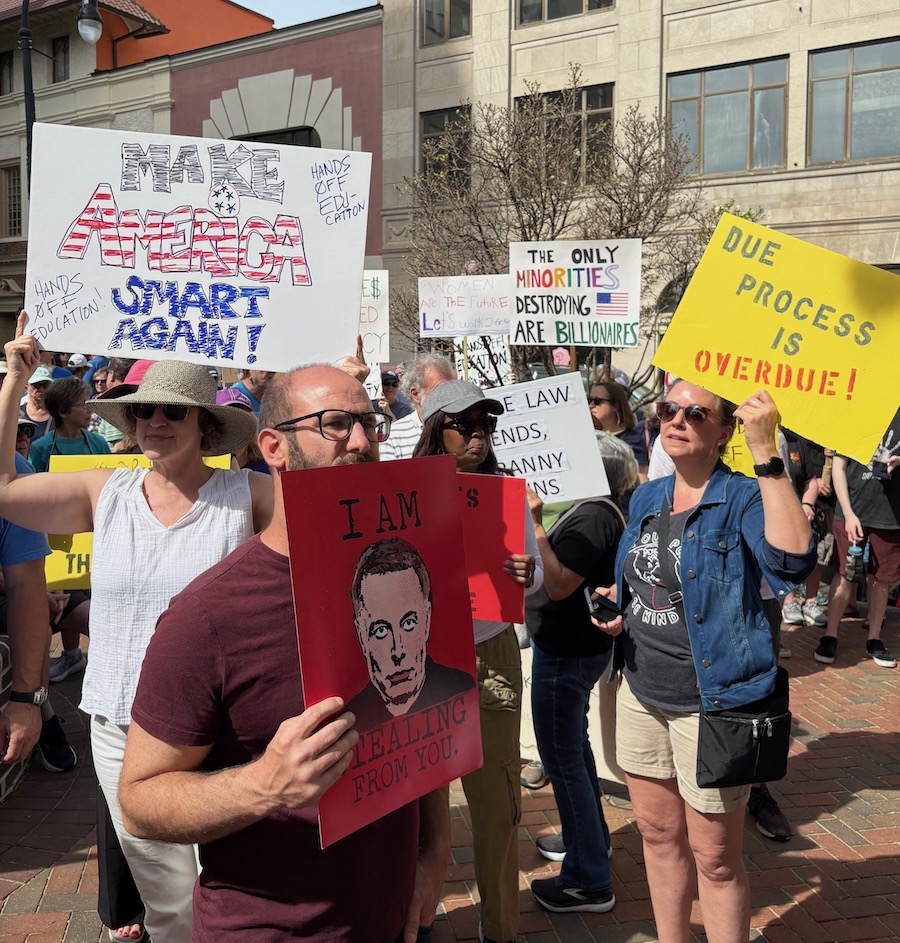
After spending the last 20-plus years of my life online, I especially enjoyed being outdoors while seeing and reading all those handmade protest signs. Many years ago, I wrote that the prevalence of earphones and personal music players had altered pop music: we no longer listened to things together, and we seldom had to subject ourselves to someone else's taste in music. Today's families don't fight over control of the car radio. While reading has always been more solitary than listening to music, there's been a parallel shift. Even if you were reading a book, magazine, or newspaper to yourself in some public setting, other people could see what you were reading and possibly start up a conversation. That's no longer the case in the age of e-book and text messages. At the Durham rally, the majority of signs consisted of white posterboard or even an irregularly-sized section of brown cardboard box and a hand-written message written in brightly-colored sharpie saying things like "Stop Trump Wrecking Ball," "Keep Medicare Strong," "Elon is the Only Immigrant Taking American Jobs," or, "I Lived Through the Great Depression. Don't Make Me Do It Again!" One handmade sign also read, "Trans is Great."
There were some more sophisticated signs with images of Musk or Trump possibly silk-screened or enlarged via home color printer, saying things like, "Elon is a Terrible President," or, "Abolish ICE." There were also a fair number of American flags. One especially large one had just 35 stars. I had to look it up. The flag had 35 stars between 1863-1865 after West Virginia became a separate state during the Civil War. I suspect the Union Civil War flag subtly riposted to the Confederate Battle Flag displayed at the Capitol during the January 6 riot. The 35-star flag had another layer of meaning: North Carolina was once part of the Confederacy.
In my brief time as a teacher, I struggled with writing on white boards. I never seemed to figure out which size of letters will fit on the board and couldn't keep the spaces between lines uniform or the lines themselves straight. I blame it on my ADHD. I had to marvel at how many people managed to get their signs spaced properly and lettered consistently (I keep alternating between print and cursive). There was, however, more to it than that. There was something genuinely inspiring by the slightly anarchic feel of all these handmade signs and the time, effort, and thought they represented. This was self-publishing in the best sense: thousands of individuals saying things in their own way and sharing it with the world. Maybe I can get a homemade looking protest sign of my own on some secret menu on Etsy?
A Visit with Dewey
On April 2, we drove to Greenville to have lunch with our friend Dewey, a 93-year-old man who befriended our late son who had essentially spent his entire adult life with a traumatic brain injury. They met in 2006 when Dewey was picketing on the sidewalk to protest the Iraq War. Our son apparently gave Dewey a thumbs up and initiated a conversation, and Dewey became one of the few lasting friends our son made after his car accident. Once at lunch (my ADHD managed to pick a restaurant in Greenville, South Carolina, instead of Greenville, North Carolina—Dewey patiently wandered downtown Greenvile, NC, with us to find a place not 200 miles away), Dewey explained he started protesting against the war in 2003 after the Bush administration lied about weapons of mass destruction in Iraq. He began appearing on the sidewalk with his signs at 71 years old, and he has done it regularly ever since. Fwiw, Dewey's signs are hand-painted but look quite professional; for some 50 years he had a business painting lines in parking lots, something he insisted on doing by hand instead of using a machine. He keeps a supply of his signs in the back of his garage along with two 20-year-old cars he maintains regularly. He attended the Greenville Hands Off Rally on April 5 and I suspect might have been the oldest participant.
After gifting my wife a couple of the dozens of quilts his late wife had sewn over the course of their married life, Dewey shared the story of how he got started as a weekly "protester." Despite the fact that Greenville is relatively liberal (Harris won Pitt County 54-46 in 2024), in the first several weeks drivers would honk at him, give him the finger and yell obscenities. Dewey confessed to being discouraged and reconsidering. About a month in, a passing driver gave him a thumbs up and smiled at him. That kept him going. When our son stopped to high five and talk to Dewey in 2006, it wasn't—at that point—the first time, but it mattered enough to kindle a friendship important to both of them. I asked him how someone who grew up on a farm in the Shenandoah Valley, a reliably Republican stronghold in Virginia, wound up being politically progressive. He explained that his father, who had lost the family farm during the depression, simply had a deep belief in "Fairness," and he lived by it.
Home
As the rally slowed down, my wife and I entertained the semi-decadent notion of getting lunch at our favorite sushi place half a block from CCB Plaza. It turned out they were closed on Saturday. Maybe the staff got time off to attend the rally? We bought some baked goods, then sat together on the swing chair in Black Wall Street Gardens. At this point, it felt more like a date than a political statement. It probably does help to share political perspectives as a couple. We've come to love where we live because kindness, fairness, and compassion matter to so many of the people we meet here. I hope we find a way to keep it that way. Meanwhile, we'll keep going to rallies, even the ones that don't draw 3,000 people, and finding other ways to say no to the overt cruelty that appears to be this administration's signal accomplishment.