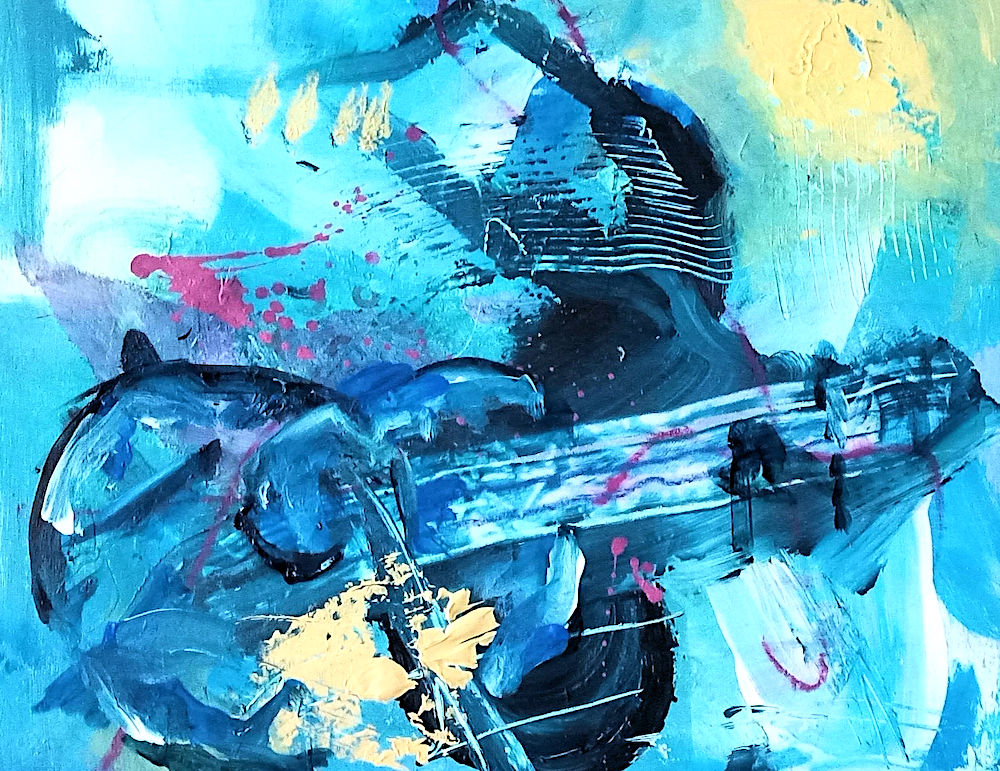
Painting by Bev Jackson
It was a seasonal May day: no saturnine clouds crammed the blue sky; the light sighs of the pine trees floated in the air as the summer wind gently brushed their leaves; and the Beas river, meandering through the valley, flanked by the jutting mountains, rattled on. Although the lofty slopes, the emerald trees, the glittering river—that landscape of wild grandeur—rippled in the streaming gold rays of the brilliant summer sun, I felt cold in the shadow of the colossus I call my father.
From afar, I saw tourists dressed in life jackets and helmets flocking around the guides with alacrity and even joy, looking forward to two hours of rugged river running. Like them, I too had an image of myself riding the rough waters of Beas, the wind pitting against my face, the dangerous rapids rocking my raft violently, like the daredevil rafters on the National Geographic channel. Now that I come to think about it, back then when I was an adolescent, I craved spontaneity, the thrill of not knowing what was to come next, to be driven by something larger than myself and my father. I was weary of my father planning my life to the last detail: finish education by 26 before his retirement, get married by 28 and have children by 33... I was tired of navigating a pre-determined route. I yearned for surprise twists and turns. But fear held me back.
To the outside world my father appeared the image of perfect geniality: always the life of the party, always the first one to strike a conversation, always the first one to laugh at a joke. But nothing could be further from the truth. To the inhabitants of our home, my father was like a dormant volcano. He exuded an aura of stillness and phlegm like a regular mountain but could erupt at any moment.
And it was I who had to brave the molten lava. My mother on the other hand, who was convinced of her own righteousness, would stand tall and triumphant not only with the conceit at her own infallibility, but also with some secret pleasure of being able to excite extremes of emotion in my father's heart by listing out his many flaws and inabilities, in the process making him feel inadequate. Worse still, whenever my father went for me, my mother chose to look the other way as if sheer inaction rendered her inculpable. Both my parents, routinely on a short fuse, would engage in noisy quarrels that often culminated in physical fights. Only then peace would be restored in our home. But my father reserved the brunt of his ire for me. With mother he would try to reason or argue. But he beat me for simply disagreeing on issues we didn't see eye to eye, or for merely talking back to him.
However, despite all that, I still bore filial affection towards my father. I don't know why. Maybe because when he came to himself, he would weep and ask for my forgiveness, and then we would pretend as if nothing had happened. Maybe because in my childhood, my father fed me stories of Hindu mythological characters like Shravana Kumar, who was an ideal son, who looked after his blind parents and went to great lengths to serve them; and Prahlada who is known for his unwavering devotion to lord Vishnu, who in spite of the repeated attempts of filicide by his cruel and wicked father Hiranyakashiypu, never stopped worshipping Vishnu. But Prahlada's defiance was of a quiet kind. And so in my adolescent years, I followed his example and continued my own silent mutiny, which found expression in small acts.
I still vividly recall my father's eyes expressing good humor and pure delight he could not repress when he agreed to go rafting. The fresh summer day dazzled him, and he refused to merely lie about indolently, basking in the enthusiasm given off by other visitors.
When our turn came, the guide motioned for us. Given the large inflow of tourists, we had no other choice but to share our raft with four other men, so I and my father scooted closer to each other to make room for others. We soon found out the people with whom we shared our raft were no novices. Though I and my father didn't paddle, we still felt a great sense of wonderment as the sublime scenery rolled by. All in all, our trip was uneventful, unblemished by accidents. But as we drifted to the frontier of our adventure, the rapids set our raft reeling, and a spray of sun-dappled mist splashed onto our faces. My eyes widened as my father's booming laughter filled the air. I somehow managed not to be overwhelmed with the joy of reveling in the newfound childlike side of my father. But my happiness was only ephemeral, for the moment we stepped into the chilling waters of Beas to reach the shore, my father's face turned red, flushed with anger.
"You never said we had to walk in these ice-cold waters," he yelled as we staggered toward shore.
"Well, it is a small price to pay for all the fun we had. Wasn't it exciting?" I retorted.
"Exciting you say! I call it an utter waste of time," he snapped back. "I have had enough of pleasing you and entertaining all your whims."
"But, Baba..."
"No buts. I am done with rafting. One time for me is enough for a whole lifetime."
He complained loudly all the way back to our car, spoiling our idyllic day out. I was mortified by everyone staring at us. All the preceding fun and thrill was forgotten in one instant, as if it never happened.
The awareness of how recurrently happiness eluded me came upon me so intensely, I could barely speak; however, I was resolute not to let my father's fury blot out our perfectly happy outing in my memory. So, in spite of my eyes getting glassy with tears, I smiled through my hair, refusing to let my father win.